

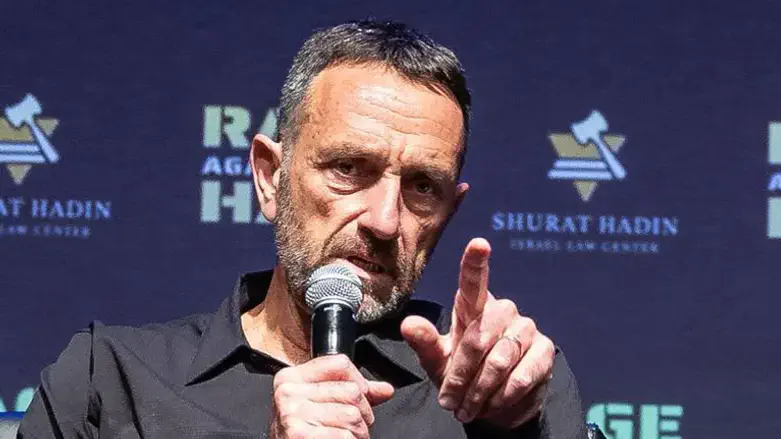
Former IDF Chief of Staff Lt. Gen. (Res.) Herzi Halevi broke his silence on the October 7 massacre on Sunday, declaring that the Hamas attack could have been prevented while firmly rejecting allegations that anyone within Israel's security establishment had deliberately assisted the terrorist organization.
Speaking at the third annual Rage Against the Hate conference, organized by Shurat HaDin at the Museum of Jewish Heritage in New York, Halevi addressed the failures that preceded the attack, the possibility of a state commission of inquiry, and the military decisions made during the war in Gaza.
Asked about claims that the October 7 attack involved an inside job or betrayal from within Israel's security establishment, Halevi responded unequivocally.
"There was absolutely no betrayal. The political echelon and the country’s leadership need to state this clearly and unequivocally."
"I can explain exactly how October 7th unfolded, down to the smallest detail. I know these individuals, and I cannot believe that any of my colleagues-after decades of service during which they risked their own lives-would suddenly decide to assist Hamas."
Halevi argued that such a conspiracy would have required numerous participants, noting that no evidence of such collaborators had emerged in the three years since the attack.
Addressing calls for a state commission of inquiry, Halevi emphasized the importance of thoroughly investigating the events of October 7 and confronting the failures that allowed the massacre to occur.
"As part of the process of learning and healing, Israel must complete its investigation and ask difficult questions-just as we have done within the IDF. This is of great importance. October 7th was a failure that could have been prevented."
He added, "We must look failure in the eye in order to be able to fix things. I look at a photograph of Shiri Bibas and see the fear in her eyes. We were not there in time to help and save her. That is the failure."
The former Chief of Staff also addressed the intelligence assessments that preceded the attack, acknowledging that Israel had fundamentally misunderstood Hamas' intentions.
According to Halevi, the prevailing assumption among the IDF, Shin Bet, and political leadership was that Hamas was not interested in launching a war against Israel. Instead, Israeli officials believed the terrorist organization was focused on governing Gaza and ultimately expanding its influence into Judea and Samaria.
Halevi said Hamas had deliberately reinforced this mistaken assessment, concealing its preparations for a large-scale assault.
He also acknowledged that Israel's strategic priorities had placed Iran and Hezbollah ahead of Hamas. "We should have gone to war in Gaza, but our order of priorities was: first Iran, then Hezbollah, and only then Hamas-because we did not know that Hamas intended to carry out an operation of this scale."
Discussing the events of October 7 itself, Halevi said Hamas leader Yahya Sinwar had sought to achieve complete surprise and initiate simultaneous attacks along the Gaza border.
He recalled that Israeli forces were attacked at multiple locations immediately after 6:29 a.m., while Sinwar believed Israel would avoid a ground invasion of Gaza because of the operational difficulties involved.
Halevi acknowledged that Israel had contributed to this perception through its previous military conduct.
He also described the warning conveyed to Hezbollah during the late morning hours of October 7, as Israeli officials feared the outbreak of a wider regional war. "We were caught by surprise in Gaza, but we are watching you closely. Should you make even the slightest move, a devastating blow will fall upon Lebanon."
Turning to Israel's military campaign in Gaza, Halevi revealed disagreements with the political leadership over the timing of the ground operation. "It took us a long time to convince the political echelon to conduct a ground maneuver in Gaza. We needed to break the pattern of small, limited rounds of conflict that relied solely on airstrikes."
He also rejected the argument that military pressure had not contributed to securing the release of hostages. "I know some people think otherwise, but without strong military pressure inside Gaza, we would not have been able to bring the hostages back. I can prove this."
At the same time, Halevi acknowledged that Israeli military operations had unintentionally killed hostages held in Gaza. "Unfortunately, we made mistakes. Our own bombs killed hostages. Of course, this was not intentional; we did not know they were there."
He said the IDF had subsequently improved its ability to identify the precise locations of hostages in an effort to prevent further such incidents.
The conference, led by Shurat HaDin President Nitsana Darshan-Leitner, brought together representatives of pro-Israel organizations, security and foreign policy experts, legal scholars, academics, and American opinion leaders.
Darshan-Leitner emphasized the need for coordinated international action against antisemitism and efforts to undermine Israel. "Our response must be an unprecedented collaboration among legal experts, diplomats, researchers, and technology professionals. It is time to shift from defense to offense, and to exact a heavy price from anyone who seeks to undermine our right to live securely in our own land."