
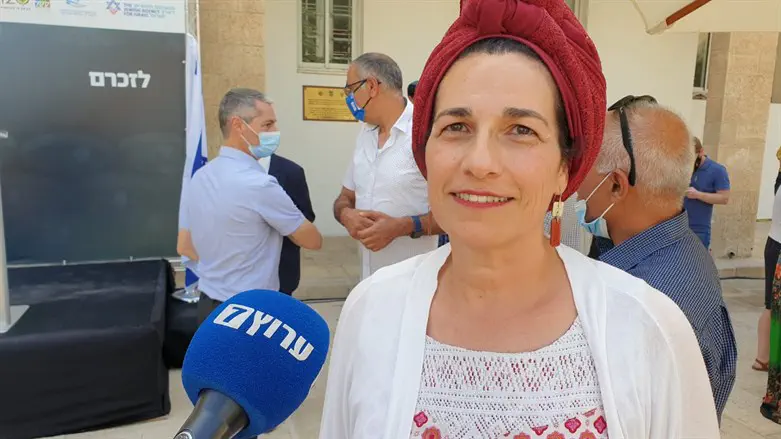
Purim is approaching, and we are still grappling the question of the wide gap between the joy that characterizes the holiday every year and the sadness and difficulties that have engulfed the Israeli society since the outbreak of the war in the south, apart from the bereavement that is everywhere. Arutz Sheva spoke to Bat-Galim Shaer, mother of Gil-Ad, one of the three boys who were kidnapped and murdered in 2014, about this struggle. Shaer deals with social empowerment and personal resilience.
Purim gives us an opportunity to think about the expression of joy in our lives," she says, recalling the power of the well-known expression "an eye in bitterness weeps and a heart is happy," taken from the piyyut (liturgical poem) "oked ve’hane’ekad," as an expression of the combined feelings required of all of us during this period, and which is even more consuming during Purim.
“Despite the difficulty,” says Bat-Galim, "the soul knows how to contain complexity. Until the war, only few people like me had to combine joy and sadness, but now, unfortunately, the circle has grown wider. There are more and more people who must to learn to live with it side by side, and it's amazing to find that we can do it. Not only can we experience both sadness and joy, side by side, but precisely at the same time. For example, when our daughter got married or a grandchild was born, these are peaks of joy and pain and they happen at the exactly the same time. I found out that we have the ability to live with this complexity."
Regarding Purim, Bat-Galim says that “we have to try to celebrate as much as possible, albeit ‘in a more sensitive and gentle way.’ There is a difference between public and personal events, how people conduct themselves in public and how they conduct themselves at home. Some families find it very difficult to cope. It's a process that one goes through step by step. You can't expect people who have experienced loss to immediately experience joy. It is a process of adjusting, but as a society we choose life. Our enemies want to see us sad and dysfunctional, and that is part of the attempt to create a routine, even not an ordinary one. We see people going out and this stems from the desire to choose life and experience joy. On Purim we are required to be in this ‘happy place,’ but this year we must be more mature. We must understand that this joy is not a state of wantonness and escape from reality, but that our lives have taken on a much deeper meaning."
The feelings, she says, are personal for each and every one, and one cannot expect everyone to cope in the same way. "We must not be judgmental and every family must do what they are capable of," says Bat-Galim, recalling the Shulchan Aruch's ruling, that one should not mourn in public on Purim, but each person must do their best in their home. This is further evidence of the need to understand each person and each family’s needs and abilities. “Halacha understands the difficulty of those who have lost loved ones to conduct themselves as usual. There are deep processes involved here but as a nation, we need to observe Purim. It won't be the same like every year, like we see the empty chairs for the hostages and soldiers at all events."
Bat-Galim believes that behavior in public will be different, but it would be wrong to cancel the events. About herself, she says that she does not manage to combine the two every year. "Inside I carry immense pain. Some years I succeeded more and some less," she says, noting the Sfat Emet's explanation of the Maharal’s commentary, “that there is no joy except for the entire thing,” and the Sfat Emet defined the term ‘Shalem’ [whole] as acceptance, acceptance of reality. "It is very difficult to come to terms with reality. Of course I would like my son to be here next to me. It took me a while, but after a while you learn to come to terms with reality, with the immense pain, and then you can also experience this joy."
The cycles of coping with the combination of sadness and joy expand as family, friends and neighbors carefully consider what and how to behave in front of those who are close up to the experience of bereavement and sorrow. Here, too, Bat-Galim sees the value of a society that has matured and become more sensitive and attentive to the plight of others. After speaking with teenagers, she sees how, even at these young ages, they already recognize and understand the complexity of life, and the depth of emotions that this complexity requires. "We didn't choose it, but it improves us as a society."