

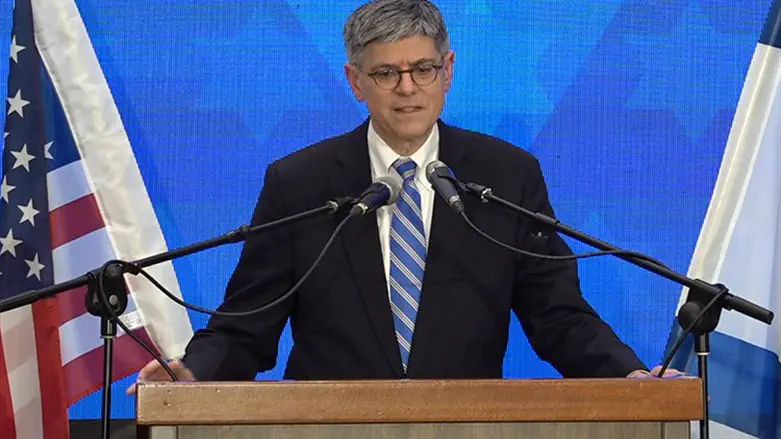
Ambassador of the United States to Israel Jacob Lew spoke to the National Israel Mission of the Conference of Presidents of Major American Jewish Organizations.
Ambassador Lew expressed his sense of honor to address the group of leaders representing a broad spectrum of major American Jewish organizations, saying that the “Conference of Presidents has long played an important role in civic life in the United States, advocating for the values of American Jews at the highest levels. The Conference has advocated for advancing core policies that are in the strategic interest of the United States, including robust support for Israel’s security and right to self-defense.”
Ambassador Lew continued that “since the horrific attacks of October 7, the close bonds between American Jewish organizations and the State of Israel and its people have played an important role in meeting the urgent needs of a traumatized nation.”
He spoke about the “diplomatic support” that the US government provided Israel, as well as the generosity and compassion provided by major American Jewish organizations, for the Israeli society at large, and especially communities and individuals directly affected by the October 7 massacre, which posed an existential threat to Israel that had not been felt since the Yom Kippur War in 1973.
Ambassador Lew also spoke about the “acts of heroism – at kibbutzim, at the Nova music festival, and in battles on the streets of Ofakim and Sderot. All the local residents who rushed to the scene of a massacre, ready to do all they could to save innocent people.”
He was proud to announce that “immediately following October 7th, the United States was the first and only nation to offer its full support to Israel, and we have not wavered. In the first days after the attack, at Israel’s lowest moment, President Biden demonstrated forcefully and unequivocally that the United States has Israel’s back. The US was the first to provide Israel with weapons that would help it ‘strike Hamas terrorists, defend against Hamas rockets, take out Hamas tunnels and infrastructure, and eliminate their stores of weapons.’”
Ambassador Lew says that “on October 18, President Biden became our first President to travel to Israel during wartime. He met with Israelis who survived the massacres, who acted heroically to save their fellow citizens, and with those whose family members were killed or taken hostage. President Biden has continued to work closely with Israeli officials, with Qatar and Egypt, and anyone we could talk to, to secure the return of the hostages as well as brokering a humanitarian pause that led to the release of many hostages – and as of today 112 people who were brutally kidnapped are once again free. I have met with the families of hostages, but amid the pain, can see unbounded resilience and endless resolve to bring their loved ones home. I pray that they will all be reunited with their loved ones soon.”
Ambassador Lew underscored the fact that “the United States stood steadfast with Israel at the UN Security Council in December when we vetoed an imbalanced resolution calling for an immediate cease-fire. US and Israeli officials are conferring nonstop, at the highest levels of government, which is a testament to the deep, deep bonds between our countries.”
But, he said, “Despite the US’s ongoing support for Israel, I have heard occasional doubts about its commitment to Israel’s security, and concerns that the US may be preventing Israel from achieving its war aims. The US is calling on Israel to recognize the need to distinguish between civilians and combatants in an environment where the enemy hides behind children and hospital patients. At the same time, basic food, health care, and sanitation should not be denied to non-combatants, especially not children. The US believes that it was crucial to address the humanitarian needs arising from a difficult war. And when history is written, I believe that our Israeli friends will be grateful for the nudge to adhere to the moral compass that we share.”
Ambassador Lew spoke about “the difficult negotiations to bring the remaining 134 hostages home.” He mentioned the dark months in Israel, but “the spirit of the Israeli people which has shed light through resilience and shared purpose.”
He said that “the US remains determined to pursue a diplomatic path to a just and lasting peace, with security for Israel and for all in the region, in an arrangement where Israel is fully integrated into the region, with normal relations with key countries, including Saudi Arabia, and firm guarantees for its long term security. This includes a path enabling the Palestinian Authority to reform, revamp and revitalize itself. This process involves a lot of hard work, and hard decisions, but will provide a life of security and hope for all people who share this extraordinary and holy land – Jewish, Muslim, and Christian.”
Ambassador Lew commented on an issue that is perceived to be a cause of some friction between the US and Israel. “The Executive Order issued by the President of the US sanctions foreign nationals who direct or participate in acts of extremist violence and terrorism in the West Bank. This E.O. is non-discriminatory and applies equally to Israelis and Palestinians.”
Ambassador Lew claimed that this is not a new situation, it has been around for years and even Israel has tried to deal with certain violent extremist settlers. It is not about all Israelis and not even about all settlers – just a small minority who pursue violent extremism.
Ending on a positive note, Ambassador Lew concluded his speech on the Visa Waiver Program, which “was an important achievement by the governments of Israel and the United States, for which my predecessor Ambassador Tom Nides, pushed hard, and for which the Conference of Presidents strongly advocated.”