

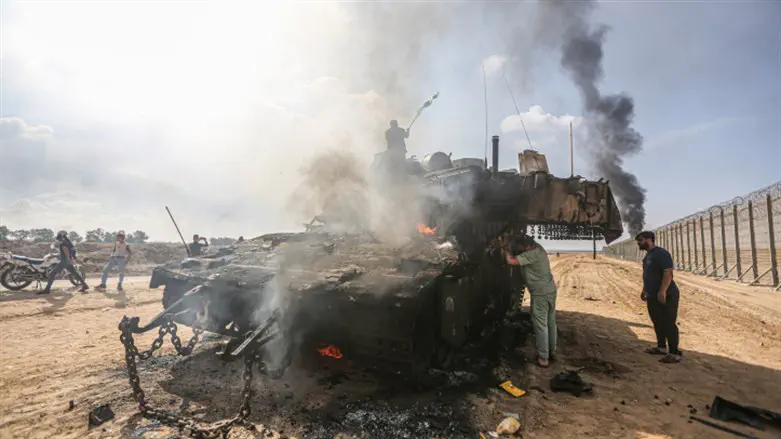
New York Times and Yediot Ahronot journalist Ronen Bergman spoke with anchor Sharon Kidon about the IDF's response to the breaching of the border fence during the October 7th massacre and the reports of the use of the Hannibal Protocol - a classified, controversial, and allegedly defunct set of IDF regulations regarding the capture of an IDF soldier by terrorists, which allows the killing of a soldier to prevent a hostage situation.
“The IAF had only two helicopters in combat readiness,” Bergman recounted. “By the time they had arrived and understood who was fighting who, which you must remember was done when some of the units that were supposed to be designated to targets had already been overcome, they needed to find alternatives, as did the command center in the Kiriya and the Southern Command. They used social media, WhatsApp groups, and calls to individuals who tried to help them determine friend from foe.”
“ There was tremendous difficulty especially while there were fighter jets flying at high altitudes, which needed to be directed where to attack.”
“There were attempts, but these attempts were stopped by the fog of war. Fog of war and lack of readiness of the IDF for combat within Israel were perhaps the worst parts of the entire incident. The IDF was not ready for a war within Israeli territory.”
“The thought that Hamas would succeed in penetrating the fence with 2000 Nukhba force terrorists, and effectively move the Border 7 km east, was something no one imagined, practiced, or even thought of. Everything connected to an actual war for homes in the south of Israel had never been practiced, and is the reason that everything will need to change.”
Regarding the Hannibal Protocol, he said “Two weeks ago, we looked for the interview with Barak Hiram where he talked about using this protocol by a different name towards Kibbutz Be'eri. That is a separate, specific, and focused incident, so I am setting it aside for a moment.”
“What happened on October 7th is that somewhere in the afternoon, the commanders realized that the Border had been completely broken through, in dozens of places, and that people are entering and leaving freely through it. All the invaders came through at that time.”
“The most important thing is to stop this traffic to prevent further reinforcements or retreat of the enemy, so that it will be possible to retake any area in which there is fighting inside Israel. This was when the incredibly difficult decision was made to stop that traffic at any price. The order was worded: ‘Do not allow enemy forces to retreat to Gaza. Prevent any such attempt at any price.’”
“The phrase ‘At any price’ is almost an exact copy of the protocol and its original form, which essentially states that there are situations in which the use of force is needed, even if it endangers the hostages.”
Regarding whether hostages were actually killed as a result, Bergman said: “The IDF estimates that there were several hours with drones and helicopters ready to fire. They were positioned along the entire border, and begin to fire at anything that moved, and they knew that they were shooting with at least some danger of hitting hostages.”
“In total, the IDF estimates that 1,000 terrorists were killed in this manner alone, a massive number. In the days that followed, special forces went out to collect bodies and cars.”
“During that operation, between 70 to 90 vehicles were found that had attempted to return to Gaza. Think of the numbers, and then realize that was only the ones hit with precise fire. They contained many bodies, all of which were brought back to Israel, and the significant majority of which were of terrorists, but not all of them. I will not enter into the operational or ethical debate present here, which I will leave to others to handle.