
Modern societies champion the individual. Individual attention, individual expression, individual autonomy.
In many regards, Rav Samson Hirsch champions the individual, too. He writes that G-d saved all three sons of Noach – and Yaakov blessed all 12 of his sons – to teach us that living a righteous life can take many forms. One person may serve G-d by being a rabbi, another by being a scientist, a third by being a businessman, and a fourth by being a butcher.
Yet, Judaism places limits on the individual. The Torah states, “All the souls that came with Yaakov to Egypt that sprang from him…were sixty-six” (Bereishis 46:26). Strangely, the word the Torah uses for “souls” in this verse is nefesh (a singular noun), not nafshos (a plural noun). Why?
Answers Rav Hirsch: “Outside Jewish circles, each son often strikes out in his own way” (which is why the Torah uses the plural “nafshos” in describing Esav’s household ). “But where the Jewish spirit is kept in truth and faithfulness, there, there may be 70 souls, [but] in all of them just one spirit and the one same feeling reigns.”
G-d wants us to develop our individual talents and strengths, but we must all be animated by the same Torah fire. We – like Yaakov’s children and grandchildren – must all be one “nefesh.”
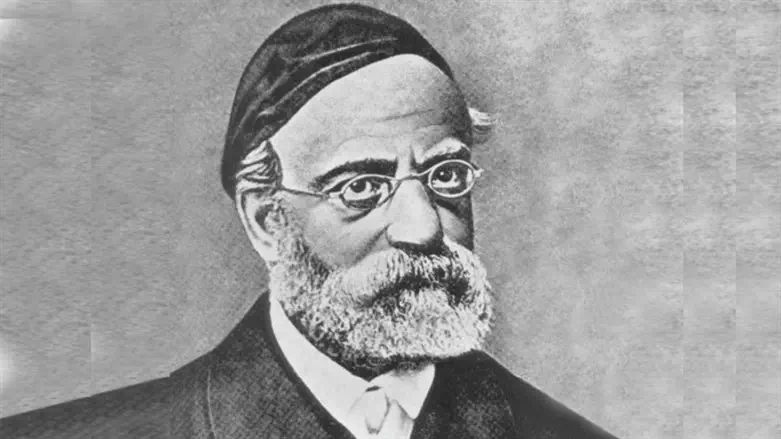
Rav Samson Raphael Hirsch (1808-1888) – head of the Jewish community in Frankfurt, Germany for over 35 years – was a prolific writer whose ideas, passion, and brilliance helped save German Jewry from the onslaught of modernity.
Elliot Resnick, PhD, is the host of “The Elliot Resnick Show” and the editor of an upcoming work on etymological explanations in Rav Samson Raphael Hirsc