

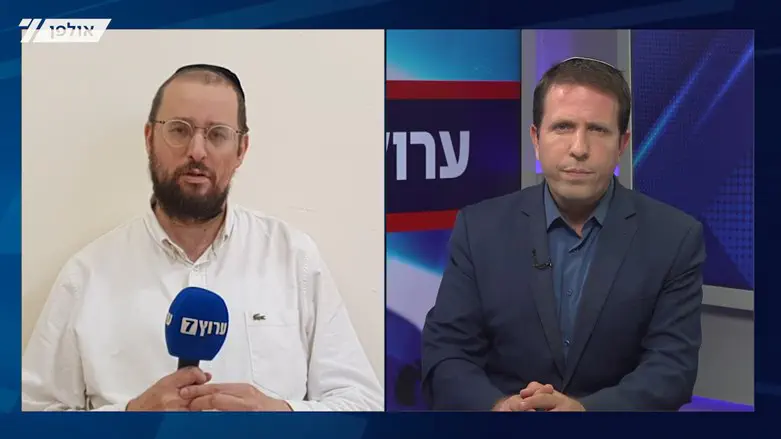
Haredi journalist and commentator Israel Cohen commented on the mobilization of the haredi sector to aid in the war and explains that this is a change in trend in the sector.
Firstly, Cohen told Israel National News - Arutz Sheva that, "It warms the heart to see such unity after a year of division, to see soldiers and yeshiva boys dancing together on base, organizations being set up that direct all their energy towards the wounded in the south and the IDF soldiers."
Cohen also answered the question of whether this mobilization is coming from the community or also from the leadership. "On the one hand, we remember the Draft Law that was constantly hovering in the background. It may be that there is interest coming from the haredi communities who are more informed about what is happening. It comes from there, so to speak, 'Here we are, in this business.' We look at the soldiers with support for what they are doing."
He noted the change that came from the leadership, when in a number of hassidic communities, at the order of the Rebbe, went to IDF bases, to comfort grieving families and even distributed food in hospitals.
"It warms the heart to see this. It comes from high and low," said Cohen, adding that "there will always be those who say, 'Why are the haredim bringing food? Why don't they enlist in the army?' And on the other hand, extreme haredi communities say, 'No, this will not give a kosher stamp to the army,' the haredi mainstream is all mobilized for the cause."
Cohen referred to a report according to which the IDF is opening up the possibility for haredi men to enlist in Phase B or volunteering posts and was asked whether this would lead to an influx of haredim to the army.
"It's a little hard to tell. I don't think the army is turning to the Ponevezh, Gur and Belz yeshiva, that would also be a mistake. They are the strength of the Torah learners, this is the secret of our strength as people who believe in tradition, but the rabbis have always said that those who cannot study should go and enlist," he explained.
"What is clear is that the army spoke of 1,500 and I think there are more, according to the reports I receive from the field, some for Phase B and some for jobs such as body identification and combat support. If the army is flexible and has an open mind to know how to accept the haredim, not to force them, then it will come from below, I think we can see a trend, but it's a long way from here to elite combat units."
He later referred to a report on a possible cut in the haredi budget in favor of the reconstruction of the communities surrounding Gaza. "This is not the time to get into this. If there are cuts in all ministries, then it is not only related to the haredim, and the haredi public should give it’s share. The communities around Gaza need to be given what’s needed for rehabilitation."
On the new-old line developing between Shas chief Aryeh Deri and Yisrael Beytenu chief MK Avigdor Liberman based on the latter's joining the government, he said that it is "difficult to know" whether this will cause Liberman to act less harshly against the haredim. "Right now he's separating the issues. He's hard to understand, it's impossible to know how to crack him." He wondered: "Well, until yesterday he sent the haredim and Bibi [Netanyahu] with a wheelbarrow to the dump and now suddenly he's sitting with them. Has he suddenly taken responsibility and we see a change in trend? We'll wait and see," he concluded.