
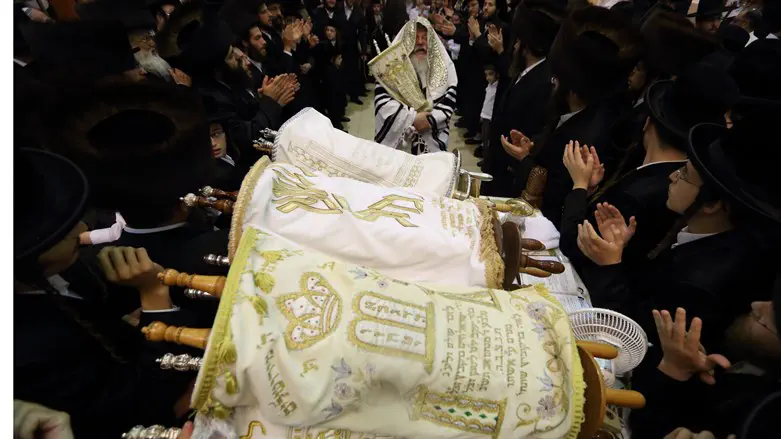
The Midrash reveals that, prior to giving the Torah to the Jewish People, God first offered it to the children of Seir (Esau), then to the children of Ishmael, and that both nations declined the offer.
This idea is derived from the following verse: “Hashem came from Sinai – having shone forth to them (Israel) from Seir, having appeared from Mount Paran, and then approached with some of the holy myriads – from His right hand He presented the fiery Torah to them [Israel].” Seir and Paran are the lands of Esau and Ishmael.
On the other hand, the Talmud relates that God offered the Torah to all the nations of the world and they rejected the offer. In fact, the nations of Seir and Ishmael encompass, on account of their importance, all the seventy nations of the world. As these two nations rejected God’s offer, then the remaining nations followed suit. Exactly whom did God address in His attempt to offer the Torah? We do not know of any prophet who represented Esau or Ishmael.
The Zohar answers that God offered the Torah to Smol, Esau’s angel. The logical assumption is that the people of Edom will follow their leader and agree to live by the Torah. As Smol wanted to know what is written in the Torah, God replied: “You shall not kill.” “The nature of my rule depends on killing,” replied Smol. “The wars which I am to wage and the conquests I live for heavily rely on the sword; I cannot agree to the Torah,” he added. Then, Smol begged God to turn His attention away from him and to approach Jacob’s children. Smol went a step further; as an incentive to Am Yisrael, he willingly donated his only attribute of holiness. It is thus written: “having shone forth to them from Seir.” God took the holiness which shone over Seir and gave it to Israel.
Next, God approached Rahav, Ishmael’s angel, with the same request. Again, the logical assumption is that if Rahav accepts the Torah, then the children of Ishmael will also abide by it.
A similar dialogue took place in heaven. “What does the Torah require?” asked Rahav. “You shall not commit adultery,” was the answer. “Woe to my lot if I should submit to this rule!” exclaimed Rahav. “How could I become fruitful and spread across the globe if I accept the Torah? Please, Hashem, give the Torah to my second brother Isaac. As an incentive, take back the special attribute of holiness which I inherited, and give it to Isaac’s children.” It is thus written: “having appeared from Mount Paran.” God took the holiness which shone over Ishmael and gave it to Israel.
According to this exchange, it is obvious that God skipped over the content of the Torah when introducing it to Esau’s angel and to Ishmael’s angel. He only mentioned two restrictive commandments, albeit cardinal in their nature. What about the remaining six hundred and eleven commandments? What is the reason behind this approach? Likewise, we shall endeavor to elaborate on the two attributes of holiness of which both angels willingly divested themselves for the benefit of Israel.
The Mishna in Avot asks: “Who is strong? He who subdues his personal inclination, as it is said: ‘He who is slow to anger is better than the strong man, and a master of his passions is better than a conqueror of a city.’” Elaborating on this teaching, the Maggid Mikoznitz suggests that every person comes to this world with his particular yetzer, evil inclination. Through some sincere introspection, it is easy to figure out the nature of one’s yetzer. Then, a person should establish guidelines as a protection against it. Thus, we find that different Talmud teachers were most careful with a specific commandment because it identified their weakness.
In line with this clarification, Rabbi Tzaddok HaKohen of Lublin adds that the specific spiritual weakness of an individual is a pointer to his potential for overcoming that failure. As an example, if one’s tendency is to act with dishonesty in business dealings, then he undoubtedly garners within him the forces to rectify this inclination. Someone else might be prone to speaking evil about his friends and acquaintances. The strength to reverse this negative trend is part of his nature and waiting to be exploited. Since he was born with that yetzer, God granted him the necessary moral strength to reverse it. One’s ability to excel in a behavior which opposes his weakness is guaranteed.
King Solomon wrote: “God has made the one as well as the other… ” Wherever holiness is manifest, impurity, its counterpart, is present in an equal intensity. Inversely, where immorality is rampant, it is a sign that the potential for ethical conduct is hidden right there. For God has created opposing forces for man’s ultimate benefit.
The continuous struggle can resolve either way, depending on man’s exercise of his free will. Consequently, Ahaz, King of Judah, who did so much evil in the eyes of God, was more prone to beget King Hizkiyahu who spread Torah across the Land of Israel. In his times, not one layman could be found from Dan, in the north, to Beersheba, in the south – all were Torah scholars. The concentration of evil is invariably paired with an equal intensity of goodness.
Likewise, Smol, Esau’s angel, was predisposed to the evil of killing. That explains why, when asked what is written in the Torah, God replied: “You shall not kill.” Nonetheless, an equal attribute of holiness was made available to Smol. So, when God told Smol that the Torah reviles killing, He was informing him of his incredible potential for overcoming this evil tendency. It is through the balancing attribute of holiness within him, for “God has made the one as well as the other…” Not only did Esau’s angel refuse to rectify his propensity toward killing, but he willingly gave away the attribute of goodness by which he could counterbalance his evil. That hidden potential for holiness was taken away from Esau’s angel and passed on to Israel: “having shone forth to them [Israel] from Seir.”
A similar scenario unraveled with Rahav, Ishmael’s angel. When he asked God what is written in the Torah? He was told: “You shall not commit adultery.” This was Rahav’s inherent evil. God revealed to Ishmael’s angel the ray of hope concealed within him, by which to counterbalance this evil. Rahav declined God’s offer and eagerly transferred away his dormant light of holiness to Israel. Now, modesty in marital relations as well as family purity will strengthen the moral character of Israel. In offering his most valued asset to Israel, Rahav stayed away from the Torah.
The Zohar adds that, at Sinai, the Children of Israel acquiesced to the Torah by declaring “na’aseh venishma,” – “we shall do and we shall hearken.” Through this acceptance, they became immune to death and evil. The antidotes to the clutch of death and to the influence of evil are the very attributes of holiness Israel received from Esau and Ishmael. Esau’s leaning to kill was countered by the unrestrained power of life, while Ishmael’s inclination to debauchery was curbed by the absence of illicit relations – evil’s main tool. Thus, na’aseh venishma, respectively correspond to Esau and Ishmael whose names equally translate into doing and listening.
Israel lost that immunity to death and evil, immediately after the sin of the Golden Calf. The Talmud introduces this idea as follows: “Says Rabbi Simai; when Bnei Yisrael said ‘na’aseh venishma,’ six hundred thousand ministering angels descended upon the six hundred thousand Israelites and crowned each one with two crowns, corresponding to na’aseh venishma. Following the Golden Calf sin, these crowns – Esau’s spiritual radiance which neutralized death and Ishmael’s attribute of goodness which reined in evil – were taken away from Israel. Rabbi Yochanan adds that they were instead given to Moses. Says Resh Lakish: ‘In the Messianic Times, these crowns will be returned to Israel.’”
What transpires from the above is that, first, God attempted to give the Torah to all the nations of the world before approaching Am Yisrael. Why then did our Sages establish a blessing over Torah reading which stands in contradiction to this fact? “Blessed are You Hashem, our God, King of the universe, Who chose us from all the nations, and gave us the Torah.” It is clear that we were not the first choice! In addition, this blessing follows a first blessing which reads: “Sweeten for us, Hashem, our God, the words of Your Torah in our mouth…”
Uncharacteristically, Torah reading is the only mitzvah which requires the utterance of two blessings! Every other mitzvah is preceded with one blessing only! And why does the Talmud qualify this blessing as the finest of all blessings?
The Shelah Hakadosh explains that at Sinai, Israel received the Torah in addition to the spiritual lights which represented the good sides of Esau and Ishmael. These are Esau’s attribute to neutralize his tendency to kill, and Ishmael’s quality of goodness which reins in evil. This is the reason for saying both blessings. The first blessing corresponds to the Torah which God gave Am Yisrael. The second blessing corresponds to the spiritual lights taken from Esau and Ishmael. God foresaw that Esau and Ishmael, who represented all the other nations, would reject the Torah. When He offered it to Israel, He also gave them the spiritual portions of Smol and Rahav. We praise Him for choosing to give us the Torah portion from all the other nations. The Sages describe this blessing as the finest.
Although these spiritual attributes were taken away from Israel following their worship of the Golden Calf, Moses shares them back with Israel when Shabbat returns. That is why Shabbat is described as one sixtieth part of Olam Habbah from where death and evil are absent.
It is not a coincidence that Shabbat is squeezed in between the days of rest of Ishmael and Esau (between Friday and Sunday). It weakens the klipot, damaging forces of Ishmael and Esau. Likewise, the additional minutes of holiness (tosefet Shabbat) that we add to the observance of Shabbat before it commences at sunset and following its conclusion at night time, contribute to the weakening of these klipot of Esau and Ishmael – the root klipot of all the seventy nations.
Furthermore, the Mishna teaches: “The world depends on three things – on Torah study, on the service of God, and on kind deeds.” In other words, if these three qualifications are not practiced, then the world will cease to exist. Ishmael inherited from his father Abraham the attribute of good deeds, for Abraham always upheld and preached the practice of chessed. Esau inherited from his father Isaac the attribute of God’s service, avodah.
Although the Torah was given to Israel, the other two pillars of the world were missing to sustain it. Knowing that Smol and Rahav would not accept the Torah, God approached them first in order to transfer these spiritual foundations from Smol and Rahav to Israel so that the world’s continuity may be assured. At Mount Sinai, Israel was chosen to uphold Torah study, the service of God, and to practice kindness. It was chosen to maintain the continuity of the cosmic system and to praise its Creator.