

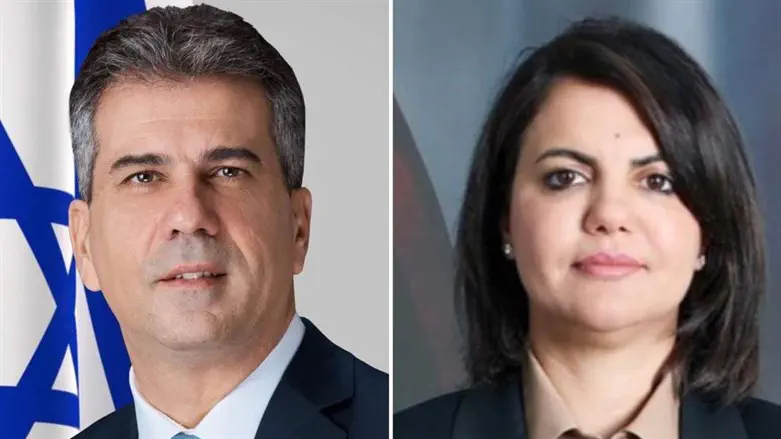
Foreign Minister Eli Cohen responded on Monday evening to the criticism that was directed at him after his ministry made public the meeting he held last week with the Foreign Minister of Libya.
"The Foreign Ministry works regularly in open and covert channels, and in a variety of secret ways, to strengthen Israel's ties in the world. The many achievements of the ministry in the past year, among them the opening of Oman's skies to flights, a trade agreement with the United Arab Emirates, two new embassies of Muslim countries, three embassies that will move to Jerusalem, and more, would not have matured without discreet preparatory actions and leading secret moves through many channels," said Cohen.
"It's a shame that political opponents, who did not promote any significant achievement, rush to react without knowing the details and blame a leak that did not exist. The attacks will not deter the Foreign Ministry and its excellent employees from continuing to work tirelessly for the State of Israel and for creating and strengthening ties with our many friends in the world, and in the Arab world in particular," he added.
On Sunday night, the head of Libya’s Government of National Unity, Abdulhamid al-Dbeibah, suspended Foreign Minister Najla Mangoush and referred her to investigation following her meeting with Minister Cohen.
It was later reported that Mangoush left the country and boarded a private plane to Turkey.
Libya’s Foreign Ministry said in a statement that the meeting between the two ministers “was accidental, unofficial, and not planned in advance.”
On Monday, Walla! correspondent Barak Ravid reported that the Biden administration issued a strong protest to the Israeli government following the disclosure that Cohen met with his Libyan counterpart.
According to US officials who spoke to Ravid, the Biden administration has been attempting for the last two years to get Libya to join the Abraham Accords. The officials claimed that the disclosure of the meeting between Cohen and Mangoush complicates those efforts.
"It killed the channel of talks with Libya and made our efforts to promote normalization with other countries much more difficult," said one American official.