

Why did Hashem get so upset at the Jewish people for requesting a king in the days of Shmuel HaNavi when a verse in this week’s parshah (Deuteronomy 17:15) seems to require the establishment of a Jewish monarchy?
Rav Samson Raphael Hirsch answers this question by pointing out that the obligation to appoint a king only applies after the Jewish people conquer and settle the Land of Israel. The Gemara (Kiddushin 37b) makes this condition explicit, but it’s already implied in the linguistic sequence of Deuteronomy 17:14: “When you come to the land that G-d, your god, gives you and have taken possession of it and dwelled in it and say: I will set a king over me…”
Unlike other nations, the Jews don’t need a king to conquer their homeland or protect it from external attack. “It is G-d who gives the land to [the Jewish people], G-d under whose support and help it conquered the land and under whose protection it lives safely in it,” Rav Hirsch writes.
Why, then, do the Jewish people need a king? To embody and further their national spirit. To “unite [their] national forces for the well-being” of their country, which depends on the “complete realization internally of G-d’s Torah.”
We need a king “just like all the other nations around” us need one (Deuteronomy 17:14). They need a king to embody and advance their national spirit (“power and strength”), and we need a king to advance our national spirit (the Torah).
The Jewish people’s sin in the days of Shmuel was asking for a king “not only similar in form,but also in the sense of all the other nations.” We wanted a king to fight our battles. And that was a mistake, reflecting a grave misunderstanding of the Jewish king’s purpose.
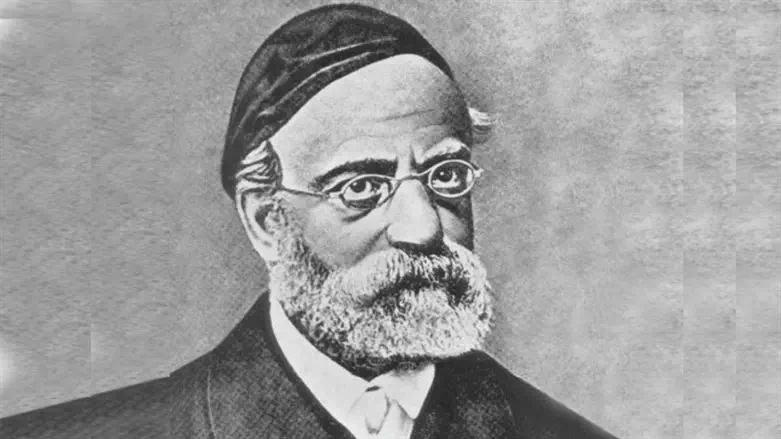
Rav Samson Raphael Hirsch (1808-1888) – head of the Jewish community in Frankfurt, Germany for over 35 years – was a prolific writer whose ideas, passion, and brilliance helped save German Jewry from the onslaught of modernity.
Elliot Resnick, PhD, is the host of “The Elliot Resnick Show” and the editor of an upcoming work on etymological explanations in Rav Samson Raphael Hirsch’s commentary on Chumash.