
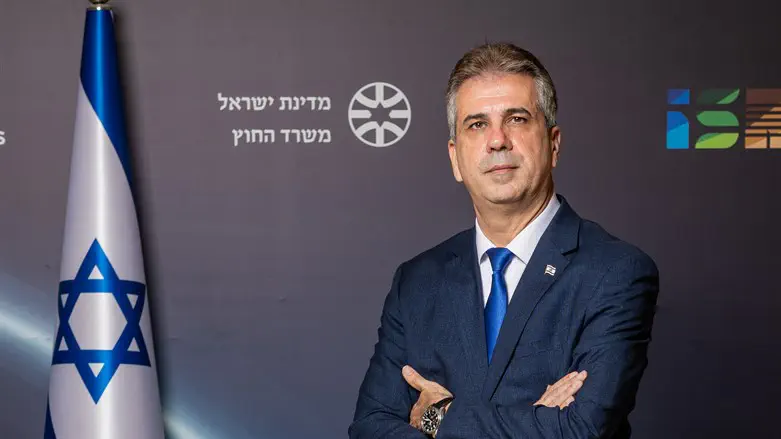
Foreign Minister Eli Cohen said in an interview with 103 FM Radio this morning (Sunday) that Israel would not allow the opening of a Saudi diplomatic mission to the Palestinian Authority following Saudi Arabia's announcement of the appointment of its first ambassador to the PA and non-resident consul in Jerusalem.
"They don't need to ask for permission from us. They didn't coordinate with us and don't need to coordinate with us, we won't allow the opening of any diplomatic mission of one kind or another," Cohen claimed.
Cohen said that the move was motivated by the progress in the normalization talks between Israel and Saudi Arabia. "The Saudis want to convey a message to the Palestinians that they have not forgotten them. We do not allow countries to open consulates. That's incompatible with our positions."
"The Palestinian issue is not the main issue in the talks. The Likud led by Netanyahu, we brought the previous peace agreements [through the Abraham Accords], and we have proven that the Palestinians are not a barrier to peace. This is not the matter that will prevent it. Agreements can be reached, it is complex but it is possible. What ultimately matters are the interests. The interests of Saudi Arabia matter no less than those of Israel. This is a window of opportunity of 9-12 months, since, after this period, this US will be drawn into an election season," he said.
Addressing the negotiations with Saudi Arabia, Cohen said: "I don't think it's correct to go into all the details. As for the negotiations between the US and Saudi Arabia, Israel is part of that peace agreement. South Korea is the country that is the closest to a nuclear threat, the US has decided to give it a protection umbrella from North Korea. I think that a defense alliance is the most correct step. I think that everything that happens in the Middle East, both vis a vis Iran and vis a vis Saudi Arabia, stems first and foremost from American interests."
He added: "South Korea is a very developed country, which can acquire nuclear capabilities. Despite this, it chose, in agreement with the US, to enter into a defense alliance. There is an issue of civilian uranium there. Our primary consideration in promoting peace agreements in general and with Saudi Arabia, in particular, is the security of the State of Israel. We will not conduct the negotiations here. The right way to promote this in my opinion is through a defense alliance, this is the right thing regionally speaking. The issue of the negotiations includes a large variety of components. There is a way to talk to the US."