
“It wasn’t my fault! Had I grown up in a different environment, I wouldn’t have acted this way!”
At the beginning of this week’s parshah (Deuteronomy 11:29), Moshe tells the Jewish people to proclaim divine blessings on Mt. Gerizim and divine curses on Mt. Eval. These two mountains stand next to each other. As Rav Samson Raphael Hirsch writes, “They both rise on one and the same soil, both are watered by one and the same fall of rain and dew, the same air breathes over both of them, the same pollen wafts over both of them.”
In other words, they share the very same environment. And yet, Mt. Eval stands “in barren bleakness” while Mt. Gerizim “is clad to its summit in embellishment of vegetation.” What explains this “striking contrast in their appearance”? Answer: The inner composition of each mountain. One is receptive to nourishment; the other is not.
And that’s precisely why G-d wanted the Torah’s blessings and curses broadcast from these mountains. To remind us that “blessing and curse are not conditional on external circumstances but on our own inner receptivity for the one or the other, on our behavior towards that which is to bring blessing.”
We are not passive victims of our environment. As Shakespeare wrote “The fault…is not in our stars, but in ourselves.” Of course, a person’s surroundings can be profoundly influential, but ultimately, we determine our fate.
Both blessing and curse hover in the air. Whether we make ourselves receptacles of the former or the latter is entirely in our hands.
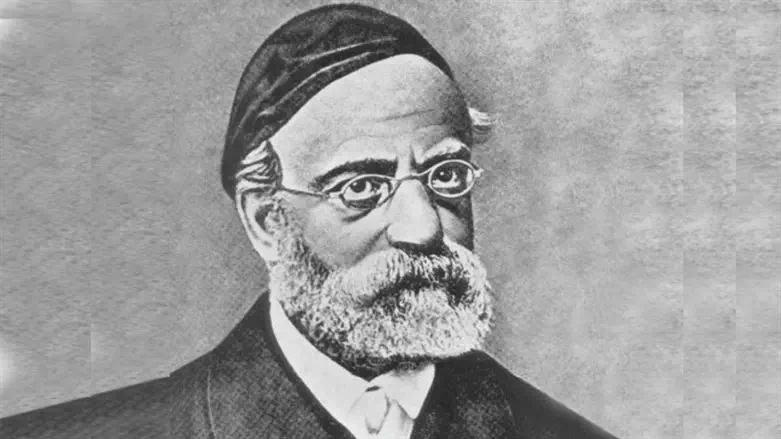
Rav Samson Raphael Hirsch (1808-1888) – head of the Jewish community in Frankfurt, Germany for over 35 years – was a prolific writer whose ideas, passion, and brilliance helped save German Jewry from the onslaught of modernity.
Elliot Resnick, PhD, is the host of “The Elliot Resnick Show” and the editor of an upcoming work on etymological explanations in Rav Samson Raphael Hirsch’s commentary on Chumash.