
Did the United States government protest former Finance Minister Avigdor Liberman's anti-Haredi statements and policies last year? Did it denounce them in the name of democracy and demand that all citizens of Israel be treated equally?
It didn’t. Why not?
I posed that question to the U.S. Ambassador to Israel, Thomas Nides.
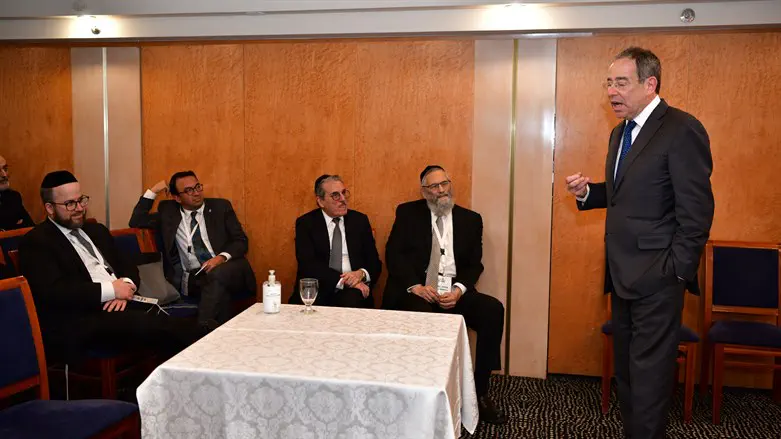
I was part of an Am Echad mission of Orthodox Jewish leaders that traveled to Israel last February to present the views of Orthodox Jews in the Diaspora to the government. We met with then-Prime Minister Naftali Bennett, Prime Minister Benjamin Netanyahu, President Isaac Herzog, and many coalition members and opposition members. We also had a meeting with Mr. Nides.
The ambassador introduced himself to our group as a Reform Jew from Duluth. He was friendly and spent almost 45 minutes with our group. He spoke about American support for Israel, the Iranian threat, the war that was then imminent between Russia and Ukraine, and other geopolitical matters.
He shared some of his own political and business experiences and, in his closing remarks, explained that he wished to encourage and support American values of democracy and equality. He expressed his admiration for the Center-Left Bennett-Lapid-Liberman coalition as the best government the United States could count on at these times.
And so, I asked him my question. Introducing myself as a rabbi and graduate of the University of Pennsylvania Law School, I noted that one of the basic principles I was taught there is that in a democracy, any law showing animus against a group is unconstitutional.
“You’re working with Avigdor Liberman,” I pointed out, “who not only has animus but has actually passed laws that he declared specifically target Haredim, the '“ultra-Orthodox'.” (actually a pejorative term in itself, ed.) Among them are laws regarding daycare subsidies, extra tariffs on disposable tableware and nonalcoholic beverages popular in the Haredi community, and laws banning basic phones, which are required by Haredi religious authorities. “Mr. Liberman expressly said he passed these laws to hurt the ultra-Orthodox communities,” I reminded Mr. Nides. “You told us you support democracy and equality. How do you view that as being democratic and equal? Why aren’t you protesting?”
Ambassador Nides hesitated a bit and then responded that he did not dispute my point but that, as the ambassador, it was not his duty to get involved in internal Israeli politics. At the time, I had no further questions.
I do, though, now.
In recent weeks, Ambassador Nides has become very vocal in speaking about internal Israeli politics, including potential ministers and their policies. Whereas at our meeting, he stated that ambassadors should not get involved in internal Israeli politics, today, he freely comments on many matters of internal Israeli politics.
I am unwilling to accept that Ambassador Nides embraces democratic values for everyone but Orthodox Jews.
So why did he reject the idea of involving himself in internal Israeli matters back in February but embraces such interference now?
To quote Ambassador Nides himself, that is not the role of the ambassador.
Rabbi Menachem Levine is the CEO of JDBY-YTT, the largest Jewish school in the Midwest. He served as Rabbi of Congregation Am Echad in San Jose, CA, from 2007 – 2020. He is a popular speaker and has written for numerous publications. Rabbi Levine’s website is https://thinktorah.org.