

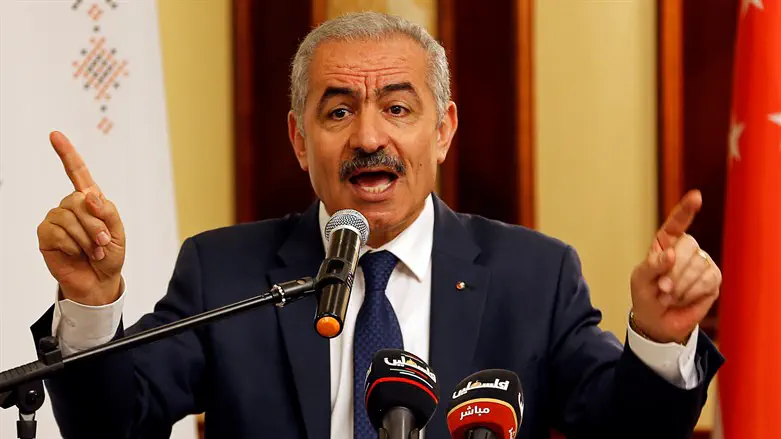
Palestinian Authority (PA) cabinet leader Mohammad Shtayyeh commented on the results of the Israeli elections, claiming that the victory of the right is a natural result of the rise in extremism against Palestinian Arabs.
"We were under no illusions that the Israeli election would produce a partner for peace," Shtayyeh said, according to Middle East Monitor.
"The rise of extreme right-wing parties is a natural result of the growing manifestation of extremism and racism in Israeli society, which our people have been suffering from for years, in the form of killings, arrests, settlements, the violation of cities, villages and towns, and giving settlers and occupation soldiers free rein to commit crimes, which all undermine the two-state solution," he charged.
The Palestinian Arabs, he stressed, will not stop their legitimate struggle to end the “occupation”, gain their freedom, and establish their independent state with Jerusalem as its capital.
"The identity of the winner in the Israeli election does not matter, as the difference between the Israeli parties is the same as the difference between Pepsi-Cola and Coca-Cola," stated Shtayyeh.
He called on the international community to live up to its responsibilities to implement international resolutions and provide protection for the Palestinian people.
This is not the first time that Shtayyeh has used the cola analogy to describe an election in Israel.
In 2019, Shtayyeh downplayed the Israeli election that took place then, saying he saw no difference between Benjamin Netanyahu and his main challenger, Benny Gantz.
“Today, there are elections in Israel. And frankly, the difference between Benny and Bibi — Benny Gantz and Bibi Netanyahu — the difference Benny and Bibi is not much of a difference between Pepsi Cola and Coca-Cola,” he said.
The peace process between Israel and the PA has been frozen since 2014, when PA chairman Mahmoud Abbas breached conditions of talks that were ongoing at the time by unilaterally joining international treaties and conventions.
Abbas has repeatedly rejected initiatives for peace, and recently restated his mistrust of Washington in resolving the conflict with Israel during a meeting with Russian President Vladimir Putin.