

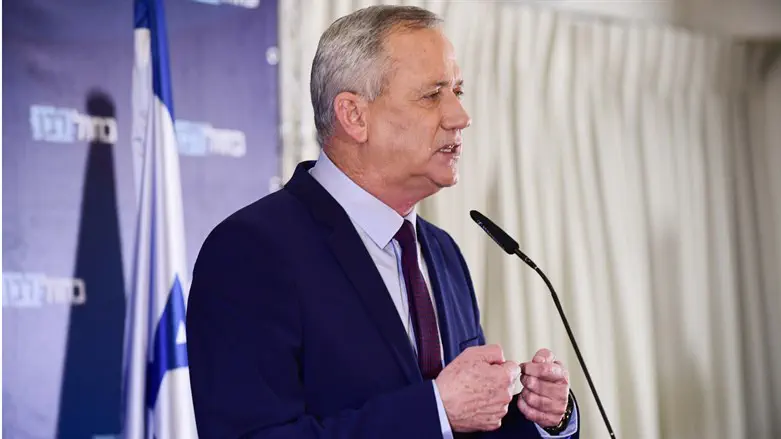
Defense Minister Benny Gantz spoke on Wednesday about the maritime border agreement between Israel and Lebanon at a joint press conference with Prime Minister Yair Lapid and Minister of Energy Karin Elharar.
“Citizens of Israel, the State of Israel faces a variety of complex security challenges – from the Iranian threat and its proxies to the necessary fight against terrorism, and the operational reality in the north and south. We will have to continue facing them, including in the near future,” Gantz said.
“We must not forget even for a moment that on our northern border stands a murderous terrorist organization, supported by Iran – an organization that holds tens of thousands of missiles. The IDF and all security forces will continue to stand guard.”
“We will not allow Iranian entrenchment and the transfer of advanced military equipment to Syria and Lebanon, and we will do everything necessary to ensure the security of the citizens of Israel,” Gantz added.
He continued: “I wish to speak today as someone who began most of his military service for the State of Israel in Lebanon over 40 years ago, as someone who knows the security reality on the ground, the costs of war, and if I may also say - the Lebanese people.”
He called the maritime border agreement “important and just” and described it as serving “the deepest interests of the State of Israel."
“The agreement guarantees continued freedom of action in the area adjacent to the coast and wherever necessary. It establishes a new ‘security equation’ with regard to the sea and the strategic assets of the State of Israel, and has the potential to reduce Iran's influence on Lebanon,” Gantz said. “I would like to emphasize that we have not given up one ‘millimeter’ that is critical to our security.”
Gantz touted the agreement’s security and economic benefits.
“Along with the security elements, the agreement is also important from an economic perspective. The agreement is also positive for the citizens of Lebanon and will help strengthen stability in the entire region,” he said.
“Indeed, the maturity date of the agreement close to the elections is not optimal – but it is necessary and therefore right to accept and uphold it because currently face a window of opportunity that may close. This agreement is in the interest of the citizens of Israel.”
According to Gantz, opposition leader Benjamin Netanyahu should have worked to create a political consensus for the deal.
“Unfortunately, we face irrelevant, political criticism by opposition leader Netanyahu. Netanyahu's opposition is unfortunate, and points to his considerations at this time. He would have done well if he had acted responsibly, influenced the agreement, and helped in gaining political consensus, just as I did with the Abraham Accords, and any other issue that was important for the citizens of Israel,” he said.
He added: “I would like to thank our American partners, the leaders from other countries in the region who contributed to this process, and of course the head of the National Security Council, the people in the Ministry of Energy, the IDF and the Ministry of Defense who have worked tirelessly in recent months. I also thank the Prime Minister who leads and manages this important issue together with me, the Minister of Energy and the Cabinet.”