
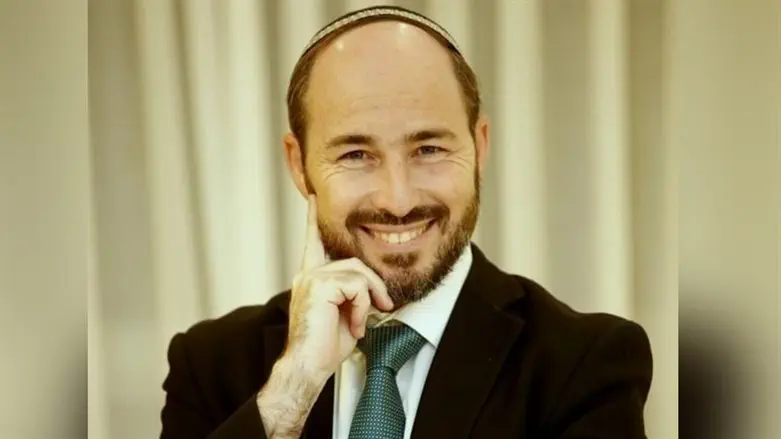
My first day at Merkaz HaRav Yeshiva was almost my last. You cannot imagine how I had looked forward to the moment I would enter the gates of the flagship religious Zionist yeshiva founded in 1924 by Rabbi Avraham HaCohen Kook, zts"l, Israel's first Chief Rabbi, sit at a shtender (student's lectern) and ascend to the heights of Talmud learning, but that first day of the yeshiva semester, the first day of the month of Elul, hit me like a ton of bricks. I still cannot explain it. Possibly it was the noise of the 500 roaring 'lions of learning' in the Beis Medrash arguing about what the Ritv"a says and what the Gaon of Vilna finds to criticize about it while I just stood there in complete shock, understanding not a word.
Maybe it was because I suddenly felt so small, just a novice at the bottom end of the food chain, after a year of being a lordly yeshiva high school senior who looked down at all the lowly freshmen. I felt like less than nothing when I looked at the scholars and brilliant students who surrounded me.
Maybe it was the long hours spent learning – from dawn to way past dark – that left me gasping for air. After 12 years in the Israeli school system, one is used to a 45 minute class and suddenly there was straight study for three solid hours.
Either way, my first day at Merkaz Harav Yeshiva was simply torture. I got through it with a horrible feeling that I had come to the wrong place, that I would not make the grade. It's way above my level, I mourned. What will become of me was spinning through my head, I counted on this yeshiva, all my dreams, my entire future centered around it. Where will I go now? What will I tell everyone? That I tried and after one day I realized that I do not belong? That I am not built for this place of learning?
I fell asleep aching and humbled, trying to hold on to a shred of hope: Yoni, give yourself a chance, a voice in my head said. Try it for another day or two before you give up. Maybe tomorrow will be different…
Well, it wasn't. The second day was as bad as the first. I couldn't figure out how this had happened to me. I felt shattered inside but was ashamed to talk about it to anyone. After all, I thought, they all look up to me, have expectations of me, and what can I tell them? That I failed?
The Torah that brings joy
The good news came at the end of the third day. We were privileged to meet with the Rosh Yeshiva, the Gaon HaRav Avraham Cahana Shapira. Truth to tell, I did not understand most of what he said and it was not an easy thing to bridge the age gap of seventy some odd years between us. But still, something in his bright countenance, the glowing joy and love of life that he evidenced mesmerized me and gave me the strength to continue trying. The end of the story is that I remained in the yeshiva for ten years and continued learning for four more years in the Beit Midrash in Shoham. I studied for ordination as a rabbi and then went on to the next level as a city rabbi and experienced many more months of Elul in the world of Torah learning. It is terrible for me to imagine that I almost missed out on all of this bounty because of a hard beginning. How thankful I am to God for granting me the strength to continue on and not miss out on the treasure that awaited me just around the corner
Giant in learning, diminutive in height
I must also thank the Rosh Yeshiva whose 15th yahrzeit is this week. He was short in stature but a giant inTorah, a halakhhic decisor (posek) , dayan, head of a yeshiva, a recognized leader who served as Israel's Ashkeknazi Chief Rabbi for ten years while Rav Mordechai Eliyahu zts"l served at his side as Sephardic Chief Rabbi. Abler scholars than I are able to speak about his level of Torah learning, but I want to share two things which are engraved deep in my heart and continue to accompany me all my years as a practicing rabbi.
And I will pray
I was amazed anew every time I saw Reb Avrum (as he was called in the yeshiva, unpretentious, modest, straight, just what he was) We all know how hard it is to give prayer one's full attention, it is even harder to concentrate during the chazan's re-reading of the Silent Prayer, which sometimes seems unnecessary to us. Why reread what we have just finished reading to ourselves? We tend to daydream, talk, some yeshiva boys even learn, in short, find something to do instead of listening so that the time goes by. Reb Avrum was different. When he davened, he totally davened. He did not lift his eyes from the siddur. He did not utter a word. Until the last years of his life when he found it difficult to stand for any length of time, he stood erect for the entire rereading of the Silent Prayer. He would stand listening carefully to each word, responding to the chazzan loudly. His siddur was packed with notes he received from people, mostly names for him to pray for –either for someone to get well, to marry or to find a way to make a living. There were brachot in the Silent Prayer that took him a very long time because he read the notes one by one in order to plead to God to fill the needs of His people. When it was time to don his coat to go home after davening, he would not allow his students to help him until he could not do it himself anymore. Despite his eighty years, he was always full of life and energy.
What is new?
He taught us to love Torah and to have a healthy curiosity without saying a word about either. On his way to his regular corner in the Beit Midrash he would notice everything on his path. He would stop at every shtender that had a book on it that was unknown to him, pause and look through it for a few moments, almost as if compelled to see if it contained a new and interesting thought or a novel way of interpreting something. In his last years, when he was very weak, and found it hard to shake the hands of the hundreds who wished to say Shabbat shalom after Friday night davening, he made sure to shake the hands of the children. Every five or ten year old was privileged to get a warm handshake and a joyous Shabbat Shalom wish from the elderly Rosh Yeshiva.
On the first day of Sukkot, when the Patriarch Avraham came as the ushpizin in the sukkah, he took our Reb Avrum with him when he left for the heavens. Those at his bedside related that the Rosh Yeshiva's last words were about the welfare of the yeshiva he so loved. The time that has passed since then has seen the yeshiva continue to grow and flourish, but has also continued of feeling of loss, the loss for his students, the religious Zionist sector and the entire Jewish people. May the light of his Torah continue to guide us.