
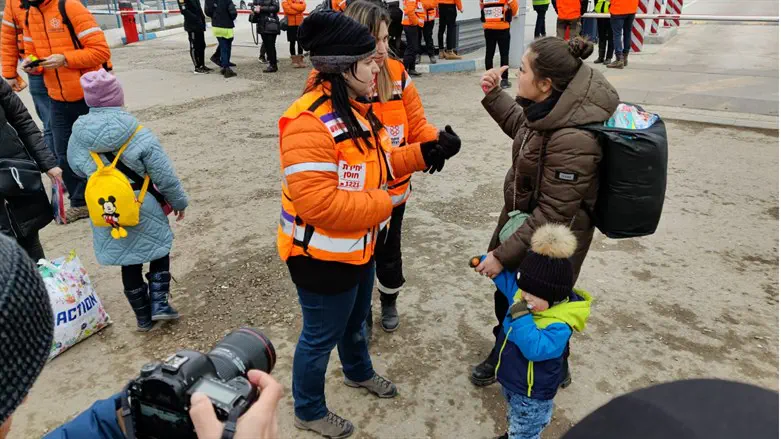
Last week, while I was stationed in Chisinau, I met a family of refugees that had fled from Ukraine. They were one of the hundreds of families that I interacted with that day who were fleeing the fighting in the war-torn country. However, I felt that their story in particular really characterized for me what's happening now as the war continues and more and more families are forced to leave their homes. Many of these people’s homes were destroyed, like this family, while others fled out of fear that they would be the next victims of a missile attack and they didn't want to take the chance of staying and the danger that this presented any longer.
As an Israeli, I feel like I understand the refugees more than most other people and that I am more empathetic towards them due to the continued threat of rockets that plagues my country. This is especially true in the southern parts of the country, where missiles are more common. Living under these conditions of constant fear and stress affects a person emotionally and mentally.
The family that we met on the border consisted of parents who came with her daughter and son, and their beloved pet cat. Their home had been destroyed by a bomb whose shrapnel dispersed throughout their home causing severe damage. They were miraculously saved because they had taken shelter in an internal room at the time of the explosion. However, the house was completely destroyed. The family fled for the border and met United Hatzalah volunteers on their way out of the country. The volunteers invited them to come along with them to Chisinau where United Hatzalah had set up humanitarian aid stations and a field hospital that provides medical care for refugees. The father was exhausted from the long drive across the country and through the border. One of the volunteers at the border took over and drove because he realized that it was dangerous for the gentleman to drive in his current state.
The next day, I traveled to where they were staying to give them emotional support as a therapist. I am a part of the organization’s Psychotrauma and Crisis Response Unit which specializes in providing emotional and psychological stabilization to those suffering from acute medical trauma, at the scene of medical emergencies or other traumatic incidents. I took a few other volunteers to with me to see if anyon else needed help, as well as for backup.
When I spoke to the father, he refused to speak with me because he said that everything was okay and he did not need any help. The grandson was also traumatized and refused to speak with me, hiding inside the whole time. I spoke with the mother and helped her figure out some ways to try to help the boy feel more comfortable and relaxed. We brought them food, supplies, medicine, vitamins, whatever they needed.
Later, while we were waiting for the taxi to pick us up, the daughter came over to us with a worried expression on her face. We asked her if everything was alright, and she said that her father wasn’t feeling good, contrary to what he had told us a few minutes ago. The daughter wanted to let us know that she was going to bring him to the hospital. We offered to take care of him instead and treat him, as we are all trained EMTs and are there for that very reason. There was no sense in taking him to the hospital, and anyway, we didn’t think it was a good idea for her to leave her troubled son at a time like this because it could make him even more anxious.
The father was extremely tense and stressed and wasn’t willing to participate as we tried to help him. However, after a few minutes, we finally convinced him to come with us to our field hospital to get checked out. Once we finished with his exam, which showed that he was healthy, a volunteer in the psychotrauma unit named Lital spoke with him to relieve him of his stress. After their session, I was happy to see that he exited upright and even agreed to come back again. I was ecstatic that we succeeded in gaining his trust because, after all, we are here to help him and his family.
I can’t comprehend what these people have gone through, the enormous hardships of leaving their home, and watching as it was destroyed. They are currently living on the border with nothing and no idea as to what tomorrow holds. They still don’t feel completely safe and comfortable, and they are understandably stressed and scared because of the war. While I couldn’t solve all of their problems, I feel confident that the help which I gave succeed will ease their pain as they continue to go through the process of starting once again.