
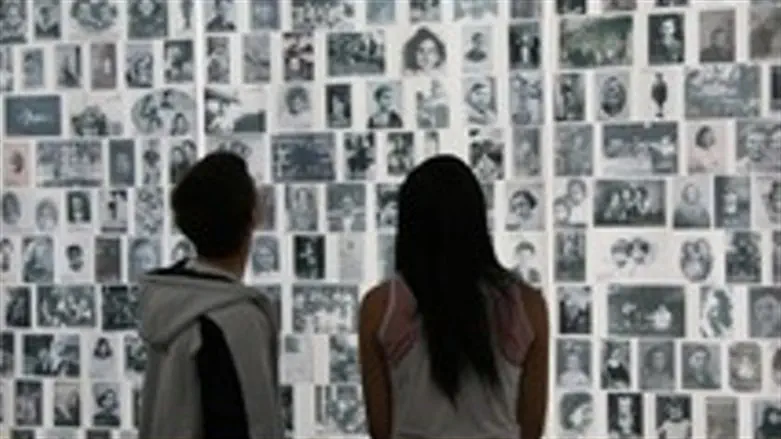
It began a few weeks ago with an innocuous e-mail link to a Yad Vashem database on the fate of Jews in Europe during the Holocaust.
The information has been made available to anyone with access to the internet through collaboration between Yad Vashem, the Museum of Jewish Heritage in lower Manhattan, and a new group called Jewish Gen.
Prior to receiving this e-mail from Jewish Gen, I never had such easy access to what could be the history of most of my wife’s extended family who were murdered by the Nazis during the Holocaust.
If you access the search tool at jewishgen.org, you will find that the search is relatively simple. All you need is the name and birthday of the person you are looking for and the city in which they may have been born or lived during those dreadful years.
In about two months we will be observing the fifth yahrzeit of my father-in-law, Hershel Nudel. He and his wife, may she live and be well, were the sole survivors of large families. I believe that for the children and grandchildren of survivors, the passage of time does not mean that the facts of what occurred dissolve into history. On the contrary, it seems that as time goes by there is somewhat of an increased interest about what happened and how it was allowed to happen.
This new database at my fingertips has recorded, where possible, basic information of 4.8 million people. When you enter a name, the following pops up on your screen: first it states whether the name can be found, then the date of birth and town in which the person lived, and the last column is labeled “Fate.”
In most instances, there are three or so choices for “fate.” Most often it lists “murdered.” In a minority of cases, the column says, “presumably murdered” or “not stated,” which basically means that the people who put this database together either lost track of or just do not know what happened to the person you are searching for. At the end of my father-in-law’s line it says, “not stated.” That means that the record keepers, whoever they are, do not know what happened to him.
There are about 17 pages of people with similar last names. Aside from Nudel, some are spelled “Nodel” and others “Nadel.” I did not count up all the names and their recorded fate, but a quick review of the various pages easily shows that 95% or more of the people on the list were murdered.
One of the notes I came across in the column labeled “fate” of one Bernard Nadel says, “Perished during the period 1933–1945 in indirect relation to the Shoah.” Several other comments I noted state: “Was registered following the evacuation to the interior of the Soviet Union.”
I’m not sure what to make of those notes, but I am projecting that there were impossible conditions to which people were subjected, and if a person was ill or took ill there was probably no mechanism for treatment or facility in which to be treated. Hence, there is a Shoah-related death, of which there must have been many.
All these decades later, it occurs to me that this is what it should have said about my father-in-law’s fate. And that is because while he was in yeshiva in Bialystok, at some point during the war the yeshiva was taken over by the Soviets and relocated to Siberia where they spent at least four years before liberation.
I have to share with the reader what it is like to peruse endless columns that record the fate of millions of people with just one simple word: murdered. It’s staggering to go through page after page of people—who each had lives in their hometown as family people or business people, etc.—and see them unceremoniously listed as murdered.
According to Avraham Groll, the director of Jewish Gen, the organization was founded in 1987. During the early years, it was composed of several hundred people, mostly genealogy buffs who were interested in researching their own family histories and roots. Today, the Jewish Gen database features over 30 million records on over 6,000 European Jewish communities and the ability to research family trees.
The other day we were visiting with my mother-in-law in Brooklyn and wanted to ask some questions about her family history so that we could delve a bit deeper. I already knew that her maiden name was Knobel and that her mother’s maiden name was Getz. We wanted to know what my father-in-law’s mother’s maiden name was, but she just did not know. She was just 9 years old when her entire family was murdered in Poland. All those family members must be there, somewhere, on one of those computer pages.
The above is just one of the many reasons why I have felt all along that during this pandemic, with the disagreements about mandates and vaccines, it is just so wrong to use Holocaust imagery to try to win an argument or make a point.
We have discovered, and the world will discover in the near future, all the awful mistakes that were made in treating COVID and the needless deaths because of those errors. The purported experts will tell you that they are adhering to and administering science, which is disingenuous because science can change and sometimes does change every day.
So when NIH Director Tony Fauci tells CNN that this is science, all he is saying is that he reserves the right to change his position on how Americans should handle the virus, and he indeed does that very often. This type of deceptive terminology has been used throughout the last two years, and those who suggested changes in the approach to corona without invoking the word “science” were roundly condemned.
Some of those on the fringes will insist that forced vaccine mandates have resulted in the death or even murder of some people. It is probably at that point that these extremists—and there are always vocal extremists regardless of the matter—will draw parallels between the Holocaust and the vaccine issue.
I cannot emphasize enough how wrong that is. Those who utilize that kind of imagery want to draw attention to their cause, but that still does not make it right or proper. The murder of six million Jews at the hands of the Nazis and their cooperating co-conspirators is unique in the history of the world.
Over the near term, the many wrong decisions on how to treat the coronavirus will be discovered. Mistakes were made, financial considerations entered heavily into the equation on how to proceed, there was the matter of status in the medical community, and media attention and recognition on the national level for some.
As bad and misplaced as some of the decision-making processes were, they were not the systematic murder of Jews as was the Nazi Holocaust. Just scan the Jewish Gen pages and read the names, some of which you might be familiar with, and read as line after line in the “fate” column just says “murdered” or “presumably murdered.”
The distinctiveness of the Holocaust experience for the victims, and now their children and grandchildren, is that the more chronological distance between those years and today, the more our interest increases instead of fades. It is abundantly clear that no matter what type of crisis comes our way, it is an understatement to compare it to the Jewish experience in the Holocaust.
Larry Gordon is editor in chief of the Five Towns Jewish Times.