

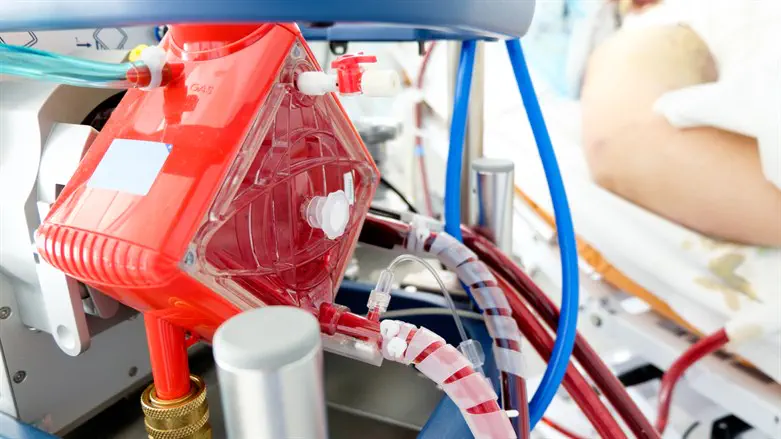
The gaps between Israel's center and its periphery are felt in all aspects of life, but especially in healthcare - including in how accessible ECMO machines, which replace heart and lung function, are.
According to Israel Hayom, in northern Israel there are just three ECMO machines, and there are 10 in southern Israel. By comparison, there are 55 ECMOs in central Israel, 13 in Jerusalem, and 12 in Haifa. These figures were told by the Health Ministry to the Finance Committee, at the request of MK Ofir Katz (Likud), who initiated a discussion on the matter.
These figures show that there are ten times more ECMOs in Tel Aviv than in northern Israel. In Tel Aviv, there is one ECMO per 50,000 residents, and in Jerusalem, there is one ECMO per 89,000 residents. In Haifa, there is one ECMO per 87,000 residents, and in central Israel there is one ECMO per 85,000. However, in southern Israel there is one ECMO per 133,000 residents, and in northern Israel the situation is even worse, with one ECMO per 489,000 people.
Dr. Sigal Libert Taub, a general surgery specialist and the head of general medicine in the Health Ministry, told the Finance Committee that in the State of Israel, there are 94 ECMO machines. These machines are purchased independently by the hospitals, but beginning in last October, a hospital which wanted to open an ECMO unit was required to receive approval from a professional Health Ministry committee. Some of the hospitals have been waiting for approval for over four months.
ECMO machines made headlines in due to their importance in saving the lives of severely ill COVID-19 patients: Sixty-five percent of those who were placed on ECMO machines recovered, and during the worst periods of the pandemic, hospitals were forced to choose which patients would receive the ECMO machines and a greater chance of survival.
Professor Hezi Levi, director of Barzilai Medical Center, trained medical staffs to use ECMO machines. According to him, "the lack of ECMO machines harms our ability to treat those who require treatment. This causes us to transfer patients to larger hospitals in the center, even though they are also overwhelmed. In some of the hospitals in the periphery, there is no machine, and that definitely harms their general ability to provide treatment."
Dr. Mickey Dudkiewicz, Director General of Hillel Yaffe Medical Center, has been waiting more than two years for the Health Ministry to approve the use of ECMO machines in his hospital.
"The lack of such a machine causes us to need to transfer patients who are in critical condition and whose lives are at risk," he said. "There was also an incident of a patient who died after he arrived at another hospital."
ECMO machines are not the only ones lacking in the periphery: The number of CT and MRI machines, as well as other services and machines, are also found in lower numbers in the periphery, even though by law, medical services must be provided to everyone equally, "within a reasonable time and a reasonable distance" from the patient's home.