
An Israeli research currently underway may answer the question of whether it is possible to contract coronavirus from contaminated surfaces.
According to Israel Hayom, the research, which was done in cooperation with doctors and researchers at Assuta Ashdod Hospital, Laniado Hospital in Netanya, and the Israel Institute for Biological Research (IIBR) in Ness Ziona, found that there is a high likelihood that coronavirus particles found on surfaces near the patient are not able to grow in a lab and are not viable.
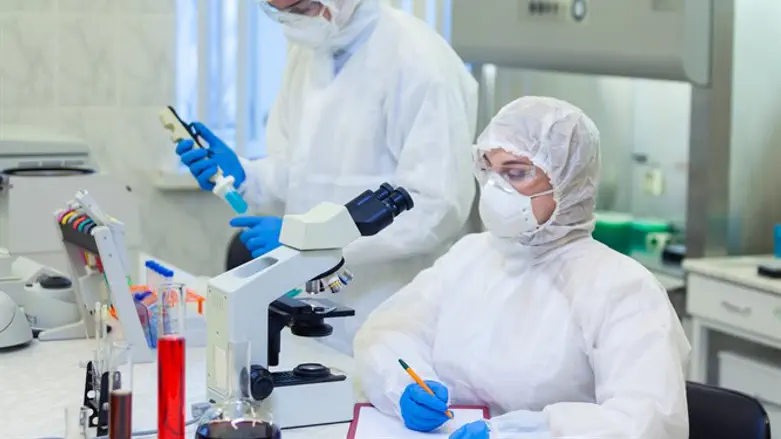
So far, the research has included samples from the coronavirus wards in Assuta and Laniado, including samples taken from surfaces which the patients themselves touched, including their mobile phones. Partial results received until now show that the virus did not succeed in growing or infecting in lab conditions.
If the other results confirm these findings, it would mean that in laboratory conditions, coronavirus particles on surfaces do not cause infection.
Dr. Tal Brosh-Nissimov, who heads Assuta Ashdod's Infectious Diseases Department and is leading the team for managing plagues, which advises the Health Ministry, led the research together with Dr. Regev Cohen from Laniado and Dr. Shai Weiss from IIBR.
"The question of infection from surfaces has been mentioned often in the media, and there were discussions regarding how long the virus lasts on various types of surfaces," Dr. Brosh-Nissimov said.
"From the outset, I will say that I am not certain that there is a lot of transmission from surfaces or contamination from surfaces. We have no epidemiological proof that anyone was infected via surfaces. We know that the virus 'contaminates' the patient's surroundings, but that doesn't mean that it's infectious. This is the first research, to our knowledge, which checked whether there was a live and infectious virus on surfaces, and in the meantime we have not managed to prove that infection from surfaces is possible."