
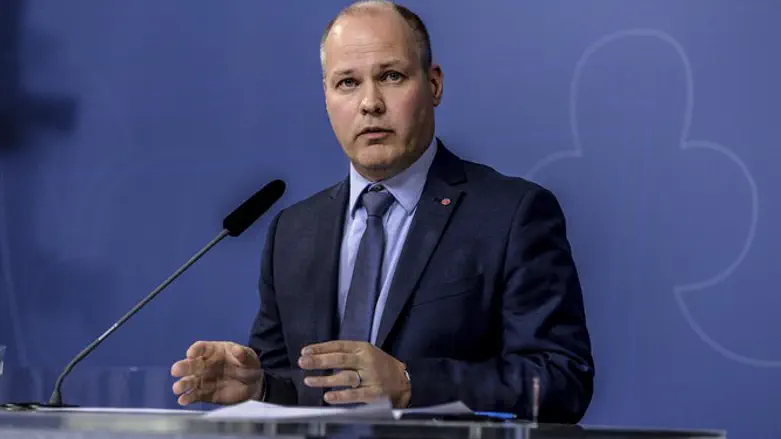
Sweden’s Justice and Migration Minister Morgan Johansson on Thursday fired back at U.S. President Donald Trump, who earlier this week riled up Sweden with comments about the crime rate in the country as it relates to its immigration policies.
At a rally on Saturday night, Trump spoke of the threat of terrorism arising from unchecked immigration.
"You look at what's happening in Germany, you look at what happened last night in Sweden. Sweden, who would believe this. Sweden. They took in large numbers. They're having problems like they never thought possible. You look at what's happening in Brussels. You look at what's happening all over the world. Take a look at Nice. Take a look at Paris. We've allowed thousands and thousands of people into our country and there was no way to vet those people. There was no documentation. There was no nothing," he said.
The Swedish Embassy in the U.S. later asked the Trump administration for a “clarification” as to what he was referring to with those comments.
The embassy tweeted: "unclear to us what President Trump was referring to, have asked US officials for explanation."
Trump later explained that he was referring to an interview broadcast on Fox News with Ami Horowitz, the director of a documentary about the violence committed by migrants in Sweden in recent years.
The president also tweeted that Sweden’s immigration policy was not working.
"The next time I hope the president, if he's going to speak about Sweden, is better informed about what the conditions really are here," Johansson told Reuters on Thursday.
Swedish unemployment figures continue to fall and public finances are in sound order, despite record number of immigrants, he added.
"We have very, very few cases of any of them (asylum seekers) committing crimes," Johansson said. "If you think that we have given protection to 143,000 Syrian refugees since 2011 you hardly ever see any of them in the crime statistics."
Acknowledging that unemployment rates for foreign-born citizens are about three times higher than for those born in Sweden and housing and social problems are rife in some areas that have taken in a large part of the refugees, Johansson said there remained much to be done.
"We have to work even harder with integration so that these people can be a part of society," he told Reuters.
"If it is anything that we know as Europeans, with our history, is where you can end up if you're playing different religious or ethnic groups against each other. It will never end well."