

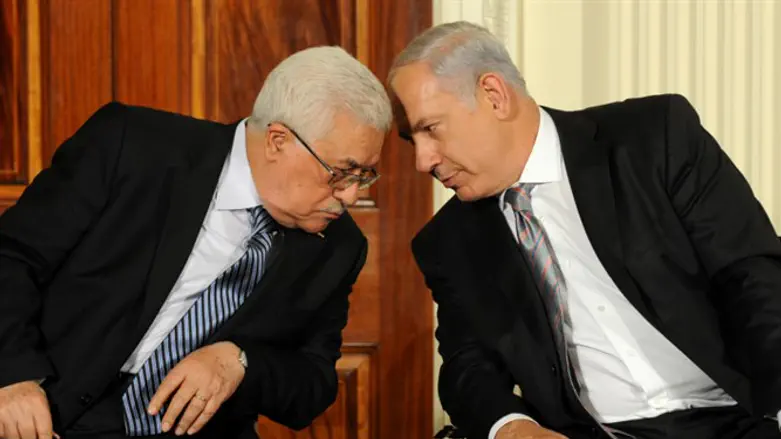
Saudi Arabian-based media has appealed to Palestinian Authority (PA) chairman Mahmoud Abbas not to dismiss the invitation extended by Prime Minister Binyamin Netanyahu for him to address the Knesset.
Netanyahu's appeal to Abbas, one of several he has made to the PA chairman, came at his speech at the UN General Assembly last week.
An editorial published on September 25 by the Saudi English-language daily Saudi Gazette and quoted by the Middle East Media Research Institute (MEMRI) said that Netanyahu’s invitation was reminiscent of the one extended by then-prime minister Menachem Begin to Egyptian president Anwar Sadat to visit Israel.
This eventually led to the signing of the Camp David agreement, which "for all its shortcomings... demonstrated that negotiations with Israel were possible," said the editorial, which also mentioned the visit of then-U.S. president Bill Clinton to the PA in 1998, which led to the amendment of the PLO charter and eventually to the holding of the Camp David summit between in 2000.
These two examples, the Saudi newspaper said, showed that diplomatic visits on that level could change the course of history.
"The Palestinians should not be too quick to dismiss the invitation extended by Israeli Prime Minister [Binyamin] Netanyahu to Palestinian [Authority chairman] Mahmoud Abbas to address Israel’s parliament [and his statement that], in return, [he would] 'gladly come to speak peace with the Palestinian parliament in Ramallah,'” said the editorial quoted by MEMRI.
“Netanyahu’s gesture was quickly rejected by the Palestinians as a 'new gimmick' but the invitation is reminiscent of the one issued by former Israeli Prime Minister Menachem Begin to former Egyptian President Anwar Sadat to visit Israel — and the rest is history. On Nov. 19, 1977, Sadat became the first Arab leader to visit Israel when he met with Begin and spoke before the Knesset in Jerusalem about his views on how to achieve a comprehensive peace to [resolve] the Arab-Israeli conflict which included the full implementation of UN resolutions 242 and 338,” it added.
MEMRI notes that the editorial is the latest indication of a shift in the Saudi position vis-a-vis Israel and of a Saudi and Arab attempt to prepare public opinion for normalization with it.
Among these indications were a July 2016 visit to Israel by a Saudi delegation headed by Maj.-Gen. (ret.) Anwar Eshki, chairman of the Middle East Center for Strategic and Legal Studies in Jeddah, and the publication of photos of the delegation with Israeli politicians.
Although the Saudi regime denied any involvement in Eshki's visit, and Eshki himself claimed that he represented only himself and that "official Saudi elements did not know of the meeting in advance, as it was of a personal nature" and was the result of an invitation by the PA, he nevertheless clarified that "the kingdom does not prevent anyone from holding such visits," and did not rule out indirect Israeli-Saudi intelligence cooperation as part of efforts to combat terrorism. A month later Eshki said he would not hesitate to visit Israel again.
Another indication of the shift in the Saudi position towards Israel is a series of highly unusual articles published in the Saudi press this July, which were harshly critical of the anti-Semitic discourse in Arab and Muslim society, and called to avoid generalizations regarding Jews.
There have been rumblings in recent years that Israel and Saudi Arabia were getting closer. Some of those claims were made by Iranian media, which asserted that Israel and Saudi Arabia had joined together to sabotage the Islamic Republic's nuclear program.
The Saudis have long promoted the Arab Peace Initiative, which says that 22 Arab countries will normalize ties with Israel in return for an Israeli withdrawal from Judea and Samaria.
Israel to date has rejected the plan due to the fact that it calls for Israel to accept the so-called "right of return" for millions of descendants of Arabs who fled pre-state Israel, effectively bringing an end to the Jewish state.
When Netanyahu said several months ago that he was ready to negotiate with Arab countries to reword the initiative, Saudi Arabia's Foreign Minister, Adel al-Jubeir, replied by saying that the initiative is “the best solution” for the Israel-Palestinian Authority (PA) conflict.